
SQUID based multi-channel Magnetoencephalography (MEG) system.
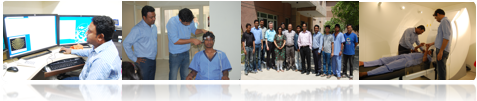
Magnetoencephalography (MEG) is a highly advanced functional neuroimaging technique for mapping brain activity by recording magnetic fields produced by electrical currents occurring naturally in the brain, using very sensitive magnetometers. The facility is located at the NBRC, Manesar. Here, arrays of SQUIDs (superconducting quantum interference devices) are used as magnetometers to detect magnetic signals from the brain to order of one millionth of the Earth's magnetic field! .
The most important application of MEG is to localize the "epileptogenic focus", in persons suffering from uncontrolled drug refractory epilepsy. The "epileptogenic focus" constitute a cluster of dysfunctional neurons within the brain which form the site of origin of epilepsy. MEG is capable of detecting this focus even in those cases where the MRI is normal, hence becomes a powerful tool to localize the "epileptic neurons" in the brain. Thus MEG provides an opportunity for a cure of epilepsy from surgery by accurately detecting the focus in the brain especially is difficult cases, where localization is not possible or not accurate using other modalities of investigations. To avoid interference from the Earth's magnetic field, the entire investigation is performed within a magnetically shielded "cage".
The other applications of MEG include basic research into perceptual and cognitive brain processes, localizing regions affected by pathology before surgical removal, determining the function of various parts of the brain, and neuro feedback. This can be applied in a clinical setting to find locations of abnormalities as well as experimental setting to simply measure brain activity.
To know more about MEG, or to schedule an appointment, contact
Contact: Prof Manjari Tripathi, manjari2tripathi@gmail.com
Video Electroencephalography (VEEG) : EEG-video monitoring refers to continuous EEG recorded for a more or less prolonged period with simultaneous video recording of the clinical manifestations. Having a correlation of the recorded behavior (video) and the EEG activity, the diagnosis of seizures or nonepileptic attacks can be made definitely in nearly all cases. EEG-video is the criterion standard for the diagnosis.
EEG-video monitoring has become available at most large referral centers with an epilepsy program, and more recently in many smaller hospitals and on an outpatient basis. As a general rule, prolonged EEG-video monitoring should be obtained on any patient who continues to have frequent seizures despite antiepileptic drugs. This facility is available at CNC, AIIMS.
The purpose of EEG-video is to answer the following questions:
- Are the episodes epileptic seizures?
- If not, what are they?
- If they are epileptic seizures, what type of epilepsy is it?
- If the seizures are focal, from where are they arising?
Contact: Prof Manjari Tripathi, manjari2tripathi@gmail.com
Nexstim System : Navigated Brain Stimulation is a new and advanced technique for accurately and reliably mapping the brain's vital functions. This is the first of its kind of facility for the country. NBS is noninvasive, which means it can be used for planning, prior to neurosurgery. Using harmless magnetic fields, NBS is a comfortable and safe method for brain mapping in adults or children with a diagnosis of tumor or epilepsy. The NBS System is as accurate as the "gold standard" of intraoperative direct cortical stimulation. Using NBS can enable more patients to be offered a surgical option and may lower risk of damage to eloquent cortex.The facility is located at the NBRC, Manesar.
Contact: Prof Manjari Tripathi, manjari2tripathi@gmail.com